
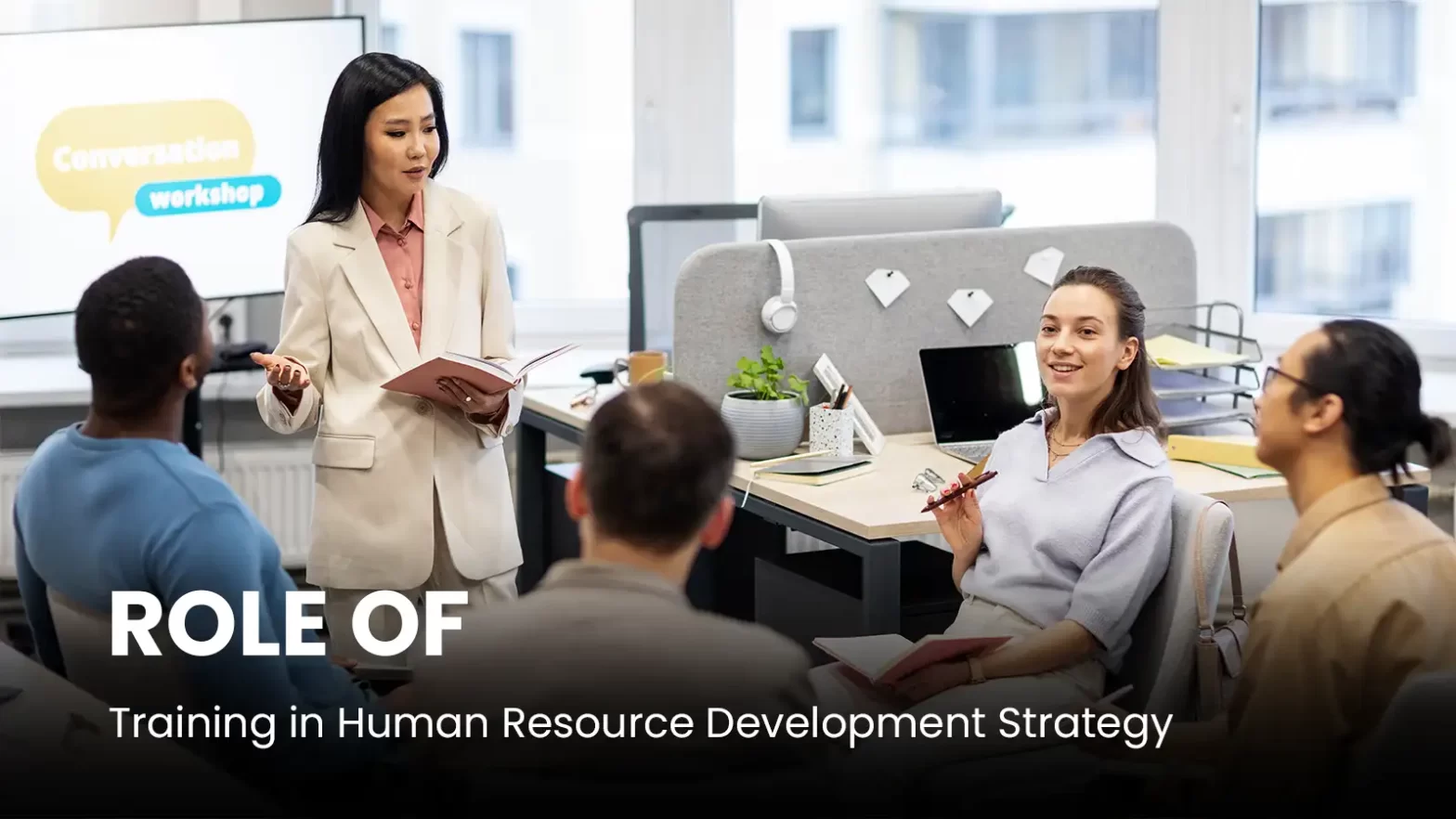
Training is no longer viewed as an activity that simply helps employees learn how to perform their current jobs. In modern organisations, it has become an important part of Human Resource Development (HRD) strategy. Businesses need employees who can adapt to new technologies, changing customer expectations, evolving processes, and growing responsibilities. A well-planned training strategy helps organisations develop these capabilities while supporting long-term business objectives.
Human Resource Development focuses on improving employees’ knowledge, skills, abilities, and overall professional capabilities. Training forms an important part of this process because it creates opportunities for employees to learn, apply new skills, and improve their performance.
Research has consistently found a positive relationship between training and organisational performance. A meta-analysis of 119 studies found that training was positively and directly associated with organisational performance, with the relationship becoming stronger over time.
What Is Training in Human Resource Development?
Training in Human Resource Development refers to structured learning activities designed to improve the knowledge, skills, abilities, and behaviours employees need to perform effectively.
It can take many forms depending on the organisation and its workforce requirements. Employees may participate in technical training, leadership programmes, communication workshops, compliance training, management development, workplace learning, or role-specific skill development.
The purpose is not simply to complete a training programme. Effective training should help employees apply what they have learned to their actual responsibilities and contribute more effectively to organisational objectives.
Why Training Is Important in an HRD Strategy
A strong HRD strategy connects employee development with the broader direction of the organisation. Training helps create this connection by preparing employees for both current responsibilities and future business requirements.
Organisations operate in environments where skills can become outdated quickly. New technologies, changing customer preferences, automation, regulatory requirements, and new working methods can all create fresh capability requirements.
Training allows organisations to respond to these changes by developing their existing workforce rather than depending entirely on external recruitment.
Recent research also highlights the growing strategic importance of training and development as organisations face technological change, skill obsolescence, and increasing organisational complexity.
Training Helps Develop Employee Skills
One of the most direct contributions of training is employee skill development.
Employees may have the right experience and qualifications when they join an organisation, but their skills need to develop as their roles change. Training provides a structured way to close knowledge and skill gaps.
For example, an employee may need to learn new software, improve project management capabilities, develop customer service skills, or strengthen leadership abilities before taking on greater responsibilities.
Continuous skill development helps employees remain capable and confident while allowing organisations to build the workforce they need for future growth.
Training Supports Better Employee Performance
Employee performance depends on several factors, including knowledge, skills, motivation, workplace conditions, leadership, and access to appropriate resources. Training can address the knowledge and capability aspects by giving employees practical tools to perform their responsibilities more effectively.
Research examining the relationship between training and job performance has found that training can strengthen employees’ knowledge, skills, competencies, and expected workplace behaviours.
However, training should not be treated as a standalone solution for every performance problem. If poor performance is caused by unclear responsibilities, inadequate resources, weak management, or unsuitable processes, those issues also need to be addressed.
Training Supports Organisational Performance
The value of training extends beyond individual employees. When employees develop stronger capabilities, organisations can benefit through improved processes, better service delivery, stronger teamwork, and more effective decision-making.
A recent meta-analysis covering 159 studies found a positive and statistically significant relationship between organisation-level training and organisational performance. It also found that the strength of this relationship varies according to factors such as training dimensions, types of human capital, outcomes measured, and organisational context.
This shows why organisations should consider training as part of a wider HRD and business strategy rather than treating it simply as an annual HR activity.
Training and Employee Engagement
Employees are more likely to feel valued when organisations demonstrate a genuine interest in their professional development. Providing opportunities to learn and grow can contribute to a positive employee experience.
Training can also give employees greater confidence in their roles. When people understand their responsibilities and have opportunities to improve their capabilities, they may feel better prepared to handle workplace challenges.
Employee engagement, however, cannot be created through training alone. It requires effective leadership, communication, recognition, career opportunities, and a supportive work environment.
Training Supports Leadership Development
Organisations need capable leaders at different levels. Leadership development should therefore form an important part of a long-term HRD strategy.
Training can help existing and potential leaders strengthen skills such as communication, delegation, decision-making, conflict management, coaching, team development, and strategic thinking.
Developing leadership capabilities internally can also help organisations prepare employees for future management positions. This creates a stronger internal talent pipeline and reduces dependence on external recruitment for every leadership vacancy.
Training Helps Organisations Manage Change
Change is a regular part of modern business. Organisations may introduce new technologies, restructure teams, adopt new systems, enter new markets, or change internal processes.
Employees need the knowledge and confidence to adapt to these changes. Training can make transitions easier by explaining new processes, developing required skills, and giving employees opportunities to practise unfamiliar tasks.
When training is included in change management plans, employees are more likely to understand what is changing, why the change is necessary, and how their responsibilities may be affected.
Training and Career Development
Employees increasingly look for opportunities to build their careers within an organisation. A clear learning and development approach can support this expectation.
Training programmes can help employees prepare for expanded responsibilities, specialist positions, management roles, and future career opportunities. Career development can also be supported through mentoring, coaching, job rotation, project assignments, and structured learning.
When employees can see a connection between training and their career progression, development programmes become more meaningful.
Training Needs Assessment Is Essential
Effective training begins with identifying what employees actually need to learn.
A training needs assessment helps organisations understand the difference between current capabilities and the skills required to achieve business objectives. It can consider individual performance, departmental requirements, organisational priorities, customer expectations, technological changes, and future workforce needs.
Without proper assessment, organisations may invest in training that has little relevance to actual business challenges.
The most effective HRD strategies therefore connect training requirements with both employee development needs and organisational goals.
Aligning Training With Business Objectives
Training should support the direction in which the organisation is moving.
If a business plans to introduce new technology, training should help employees develop the necessary technical capabilities. If the organisation wants to improve customer experience, relevant employees may require communication and service training. If expansion is planned, leadership and management development may become more important.
This alignment ensures that training investment contributes to meaningful organisational outcomes.
Research on HRD has found that training and development can contribute to organisational performance when combined with broader factors such as employee capabilities, attitudes, behaviour, and organisational context.
Measuring Training Effectiveness
Completing a training programme does not automatically mean that it has been successful. Organisations need to understand whether employees have learned the intended skills and whether those skills are being applied in the workplace.
Training effectiveness can be assessed through employee feedback, knowledge assessments, practical demonstrations, performance indicators, manager observations, productivity measures, and other relevant business outcomes.
The appropriate measures depend on the purpose of the training. For example, leadership training may be evaluated through management effectiveness and team outcomes, while technical training may be assessed through accuracy, productivity, or process performance.
Creating a Continuous Learning Culture
A successful HRD strategy should not depend only on occasional training sessions. Organisations can create stronger development environments by encouraging continuous learning.
Employees can learn through formal training, coaching, mentoring, peer collaboration, practical projects, digital learning platforms, and day-to-day workplace experiences.
A culture of continuous learning helps organisations remain adaptable because employees become more comfortable developing new capabilities as business requirements change.
The Role of Training in Long-Term Business Growth
Training contributes to business growth by helping organisations develop the people required to execute their strategies. New technology, new markets, improved services, and operational expansion all require employees with appropriate capabilities.
Instead of viewing training as a cost that produces short-term benefits, organisations can treat employee development as an investment in organisational capability.
Evidence from HRD research indicates that development can improve employee competence and commitment, which can subsequently contribute to organisational performance.
The results are strongest when training is relevant, supported by management, and connected to practical workplace requirements.
Training as Part of a Wider HRD Strategy
Training is important, but it should work alongside other HRD activities. Recruitment, performance management, career development, leadership development, employee engagement, succession planning, and organisational development all influence workforce capability.
When these areas work together, organisations can create a more integrated approach to developing people.
For example, performance reviews can identify development needs, training can address those needs, managers can support employees in applying new skills, and career planning can provide opportunities to use those capabilities.
This creates a continuous cycle of learning, application, feedback, and development.
How Success Options Can Support Organisations
Success Options helps organisations strengthen their people and organisational capabilities through practical approaches to HR, leadership, training, and organisational development.
A well-designed training strategy should reflect the organisation’s business objectives, workforce requirements, and future capability needs. Professional guidance can help organisations identify development priorities, structure appropriate learning initiatives, and connect employee development with wider business goals.
Also, Read The History of Organisational Behaviour Explained Simply
For organisations seeking HR consulting, employee development, leadership development, or organisational development support in Surat and beyond, a strategic approach can help turn training into a meaningful part of long-term business growth.
Conclusion
Training plays a central role in Human Resource Development because it helps organisations build the knowledge, skills, and capabilities required for both current performance and future growth. When training is aligned with business objectives, supported by managers, and connected with wider HRD activities, it can contribute to employee development, organisational effectiveness, and long-term performance.
The most effective organisations do not treat training as an isolated HR activity. They make learning part of their wider strategy by identifying capability gaps, developing employees, measuring outcomes, and creating opportunities for continuous improvement. For businesses looking to strengthen their workforce and build sustainable organisational capability, a well-planned training and development strategy can provide a strong foundation for future success.
1 comment